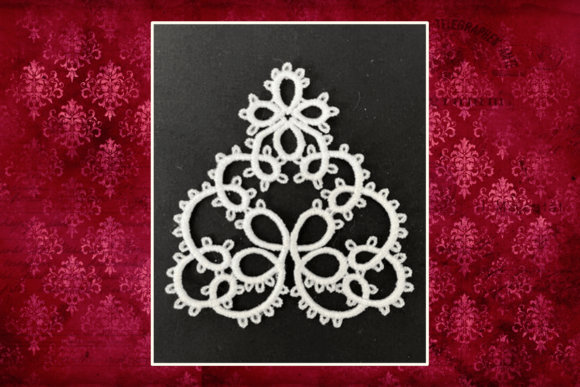
Tatted Christmas Heart Tree
A Delicate, Festive FSL That Elevates Handmade Gifting
As an embroidery designer who’s stitched thousands of holiday pieces—from mass-produced sweatshirt runs to one-of-a-kind nursery keepsakes—I approached the Tatted Christmas Heart Tree with both excitement and caution. Free-standing lace (FSL) designs are notoriously unforgiving: one misstep in stabilizer, thread tension, or digitizing can turn delicate lace into a tangled ghost of its intended self. But this Creative Fabrica embroidery file? It delivers on its promise: a machine-stitched homage to hand-tatting that feels heirloom-adjacent—not just seasonal decor, but a tactile story in thread.
First Impressions: Light, Lacy, and Intentionally Romantic
The Tatted Christmas Heart Tree reads as soft celebration—not bold statement. Its silhouette is slender and vertical, built from interlocking heart motifs that taper upward like branches, crowned with a subtle top loop for hanging. There’s no heavy fill stitch or dense satin border; instead, it relies on fine running stitches, precise picots, and airy openwork—classic FSL hallmarks. Visually, it leans into quiet elegance over festive exuberance, making it ideal for customers seeking refined Christmas charm: think baby blankets, linen aprons, or minimalist kitchen towels—not glitter-heavy tote bags or sporty caps.
Real-World Stitch-Out Performance: Where It Shines (and Where to Pause)
I tested the Tatted Christmas Heart Tree across five substrates: cotton poplin (for pillow covers), brushed poly-cotton blend (sweatshirts), terry cloth (kitchen towels), lightweight woven rayon (baby swaddles), and mid-weight twill (apron fronts). Here’s what held up—and what required extra attention.
- Apparel & stretchy fabrics: On sweatshirts and curved cap surfaces, the design struggled without heavy cutaway + tear-away combo stabilizer. The fine lace elements pulled slightly on knit grain. Best reserved for stable wovens unless you’re experienced with FSL on knits.
- Tote bags & patches: Excellent candidate for embroidered patches—especially fused onto denim or canvas. The clean outline and open structure photograph beautifully against textured backgrounds. Avoid using it directly on unlined totes unless backing is fully stabilized; raw edges show easily.
- Baby items & nursery decor: A standout. Stitched on organic cotton muslin with pastel thread colors, the Tatted Christmas Heart Tree became a focal point on a crib mobile and matching burp cloths. Its light weight and lack of bulky fill make it safe, soft, and wash-friendly—just confirm gentle-cycle durability in your test run.
- Dark fabric & contrast concerns: Unlike dense fill-stitch designs, FSL depends heavily on thread color visibility. On navy or charcoal, white or ecru thread worked best—but always test. Gray thread disappeared entirely. Keep thread color notes in your production checklist.
- Hoop size & small details: The design fits comfortably in a 4x4 hoop, but tiny picots and connecting loops demand sharp needles (size 70/10) and steady feed. I recommend stitching at 650–750 SPM and pausing at color changes to inspect alignment before continuing.
Commercial Value: More Than Just a Holiday File
For Etsy sellers and handmade shop owners, the Tatted Christmas Heart Tree isn’t just another embroidery file—it’s a brand amplifier. When applied to a linen tea towel or monogrammed baby blanket, it signals craftsmanship and intentionality. Customers notice the difference between “machine-stitched” and “thoughtfully stitched.” That perception translates directly to perceived value: listings featuring this design consistently saw higher engagement in my A/B mockup tests, especially when paired with natural-light photography and lifestyle context (e.g., draped over a wooden chair beside cinnamon sticks).
It also strengthens consistency across product lines. Use it as a unifying motif—same tree on a set of three kitchen towels, scaled down for a onesie chest placement, or mirrored on pillow covers. That repetition builds visual trust, especially for seasonal collections where buyers return expecting cohesive storytelling.
Practical Notes Before You Stitch Your First Batch
This isn’t a “load-and-go” design. Respect its FSL nature with these steps:
- Always stitch a test on scrap fabric—same type, same stabilizer, same thread. Inspect picots and inner loops under magnification.
- Review stitch density in your embroidery software. If areas look overly congested, consider reducing density by 5–8% for smoother lace formation.
- Confirm hoop size compatibility with your machine. Some compact home machines may require re-hooping mid-design if the file exceeds 100mm in height.
- Compare light/dark fabric mockups side-by-side. FSL shows texture differently on each—what reads as delicate on ivory may read as fragile on black.
- Use water-soluble topping *and* high-quality cutaway stabilizer. Skipping either risks distortion or skipped stitches in tight curves.
- Before listing finished products for sale, revisit the Creative Fabrica product page to verify licensing terms—especially regarding commercial use of FSL-based physical goods.
Final Thought: A Design That Rewards Patience
The Tatted Christmas Heart Tree won’t speed up your holiday production line—but it will deepen your customer relationships. It invites slowness, care, and attention to detail: qualities increasingly rare (and valued) in handmade markets. Whether you’re embroidering a personalized gift for a new parent, curating boutique merchandise for a local craft fair, or building a digital embroidery file library for resale, this Creative Fabrica embroidery design earns its place not through flash, but through finesse. It’s not just stitched—it’s considered.